
Where Sanger Directory Volumes Survive
Sanger directory research begins in the Fresno County Public Library's Genealogy & Local History Library, where the county's strongest run is held chiefly on microfilm with some recent hardcopy. Polk-Husted, later R.L. Polk, covered all or most of Fresno County from 1907-1957. After that countywide run narrowed to Fresno city, five standalone Sanger Polk volumes remain: 1965, 1972, 1974, 1976, and 1978. Haines criss-cross volumes restore a reverse address layer around 1972/73 and include Madera, Kings, and Tulare counties. A Sanger search must use both town-specific books and countywide titles.
| Collection | Years | Where Held | Access |
|---|---|---|---|
| Polk-Husted, later R.L. Polk countywide directories | 1907-1957 | Genealogy & Local History Library, Fresno | Microfilm, some hardcopy |
| Standalone Sanger Polk volumes | 1965; 1972; 1974; 1976; 1978 | Genealogy & Local History Library | Microfilm or hardcopy as cataloged |
| Haines criss-cross directories | Around 1972/73 onward | Genealogy & Local History Library | In-person reverse lookup |
| Rural telephone directories | 1909 onward, with title changes | Heritage Center collection | Microfilm or hardcopy |
| Sanger Herald microfilm | September 1920-December 2008 | Genealogy & Local History Library | 77 reels, image search |
| Sanger Sanborn map editions | 1891-1945 selected editions | Library and Library of Congress | Early editions online, later local microfilm |
The countywide set is not continuous. Documented gaps include 1874-1880, 1885-1888, 1897, 1899, 1930, 1943, 1945-1946, and 1948. Phone books bridge the years between Polk issues. The first county telephone directory appeared in 1909. Fresno city received its own book in 1946, while rural communities stayed in the six-county edition. Rural scope became Fresno-Madera-Mariposa-Merced in 1953 and Fresno-Madera in 1984, so a title that does not say Sanger can still hold Sanger households.
The library's detailed directory holding list is the best check before a research visit because it names the standalone Sanger issues instead of leaving the years hidden inside a broad county heading.
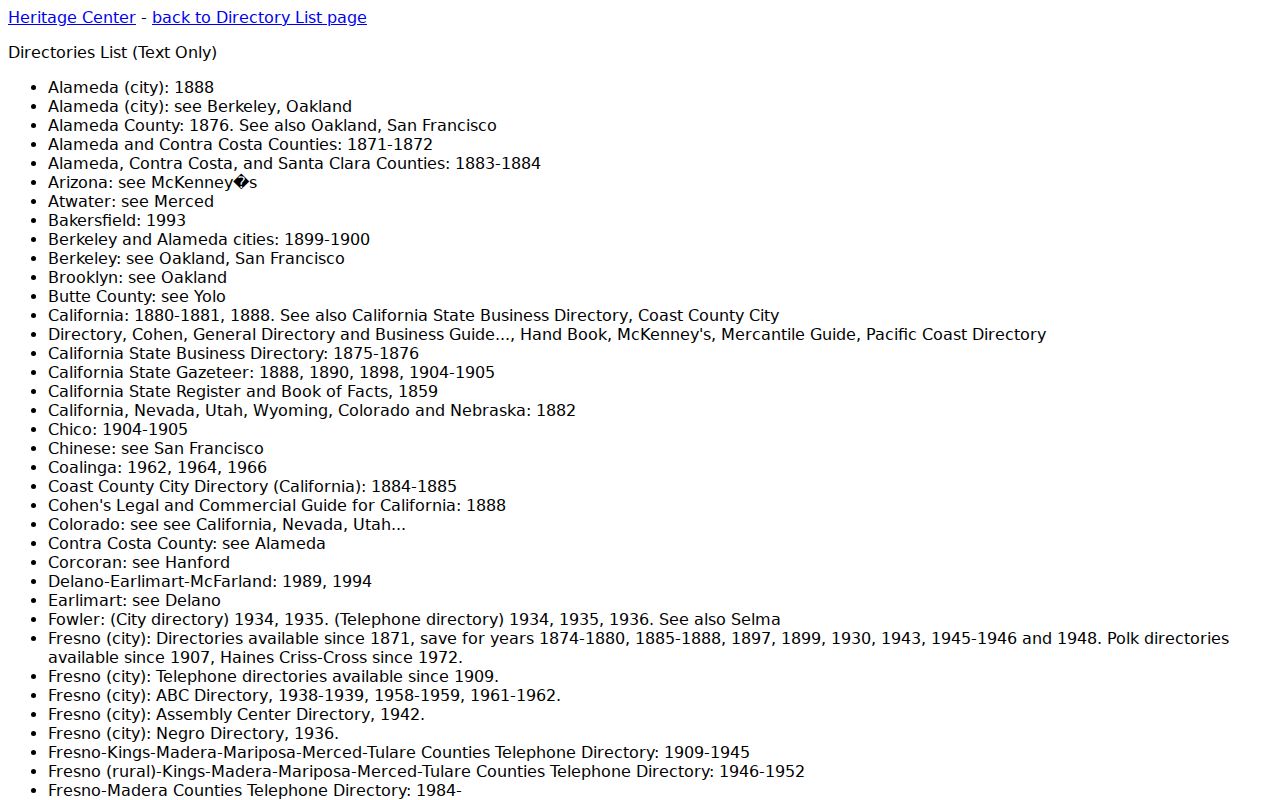
The holding list makes the five Sanger Polk years visible at a glance and helps separate a true gap from a volume held under a wider Fresno County title.
Fresno's Genealogy Room Holds Sanger Directories
The current Fresno County Public Library Genealogy & Local History Library, described as the Heritage Center on legacy pages, is at 5769 N First St., Fresno, CA 93710. Call 559-600-6230 or email HeritageCenter@fresnolibrary.org. Posted hours are Tuesday 10-5, Wednesday noon-7, Thursday and Friday 10-5, and Saturday 10-2; it is closed Sunday and Monday. The collection is chiefly microfilm with some recent hardcopy, and staff offer bookable one-on-one help. Older pages that show 2420 Mariposa are stale for visiting.
The historic directory guide explains publisher changes, telephone geography, and the criss-cross layer that a name-only search can miss. Bring the target name, a likely year, and any known street spelling. A staff member can point to the right reel or volume before a long scan begins.
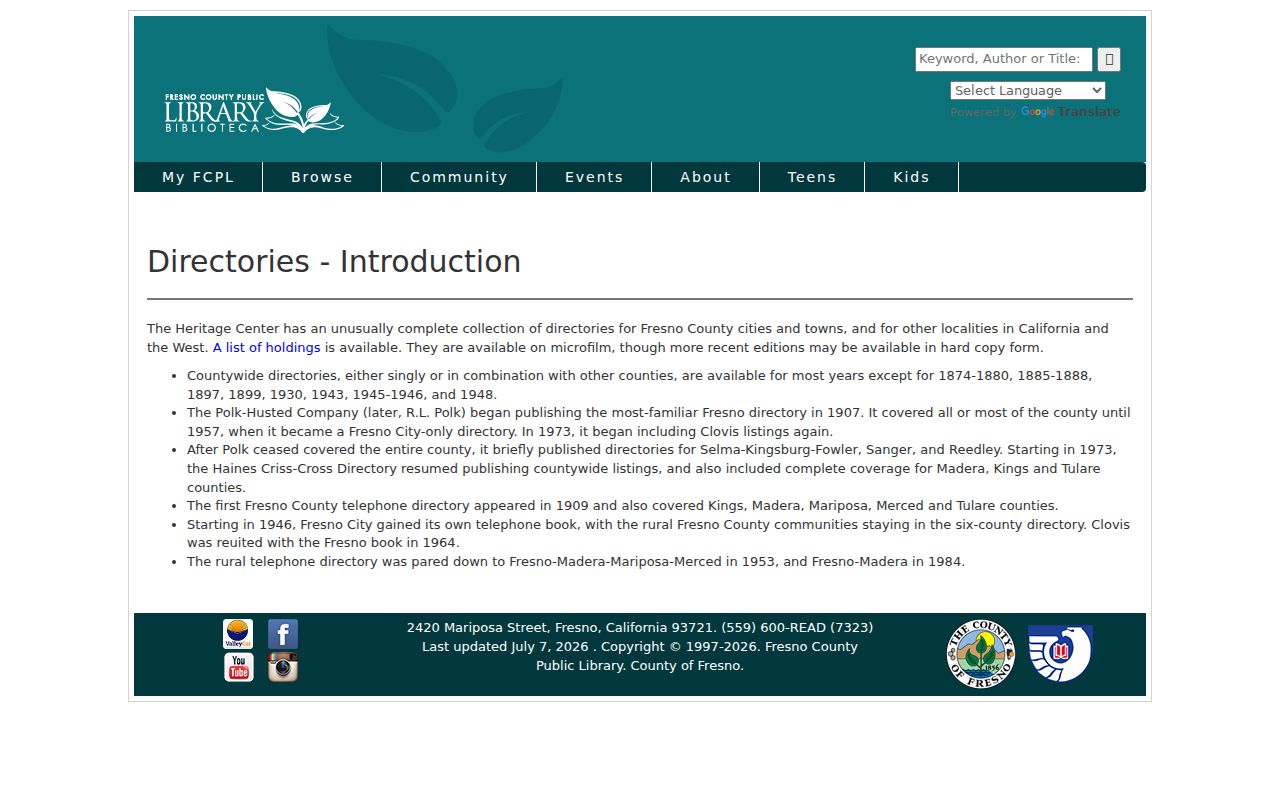
The guide is useful when a Sanger volume is shelved under Fresno County, a rural telephone title, or a reverse directory label.
FamilySearch access adds another path for historical finding aids and restricted images. The library is a FamilySearch Affiliate Library, so some material that cannot be opened from home may be viewable at a library workstation. That access supplements the local shelf; it does not replace a certified copy from the county custodian when proof is needed.
The Genealogy and Local History Library overview describes the collection services and the FamilySearch Affiliate route behind the research desk.
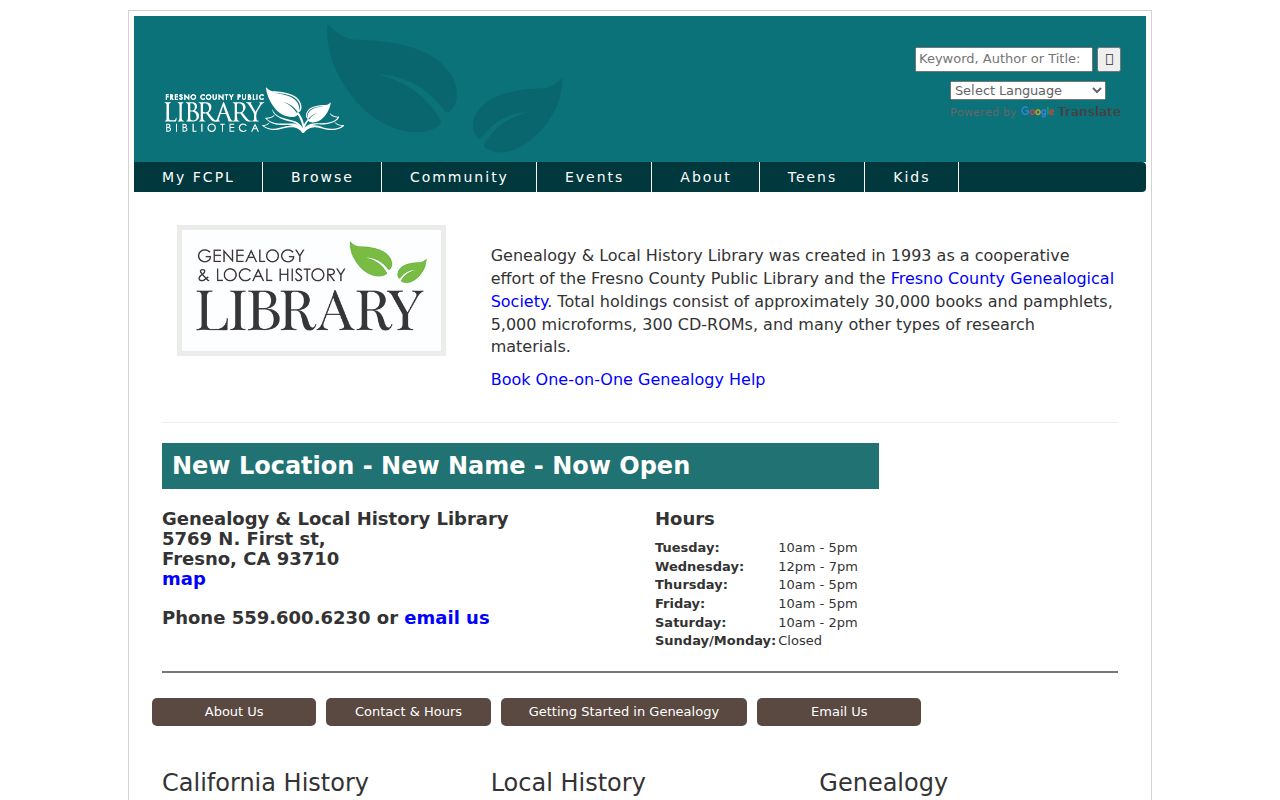
Library access brings directories, newspapers, maps, yearbooks, and genealogy referrals into one research stop, which is especially helpful when a name changes form across decades.
Sanger Directory Years Change with the Town
Sanger's directory trail follows both publisher choices and the growth of local library service. The town was founded in 1888 and incorporated in 1911, while the records that now support family history were gathered through county offices, telephone companies, schools, newspapers, and library microfilm.
- 1907: Polk-Husted, later R.L. Polk, begins the familiar Fresno directory run.
- 1909: The first county telephone directory covers a broad six-county rural area.
- 1946: Fresno city receives a separate telephone book, while rural communities remain in the larger edition.
- 1957: The countywide Polk coverage ends, making phone books and later Sanger issues more important.
- 1965: A standalone Sanger Polk volume survives in the local collection.
- 1972, 1974, 1976, 1978: Four more standalone Sanger Polk volumes mark the later town run.
- Around 1972/73 and 1984: Haines criss-cross volumes restore countywide reverse coverage around 1972/73, while the rural telephone title later narrows to Fresno-Madera in 1984.
Sanger Branch Library at 1812 7th Street, 559-875-2435, offers local catalog and database access. Its posted hours are Monday-Thursday 10-8 and Friday-Saturday 10-5, with Sunday closed. The branch began as a free reading room in an Episcopal church in 1910, received a $10,000 Carnegie building grant in 1916, and moved to its present 8,994-square-foot building in 1967. Deep local history work belongs at the central genealogy room.
The Sanger Branch history and service page helps confirm branch hours and local library context before using it as a first stop.
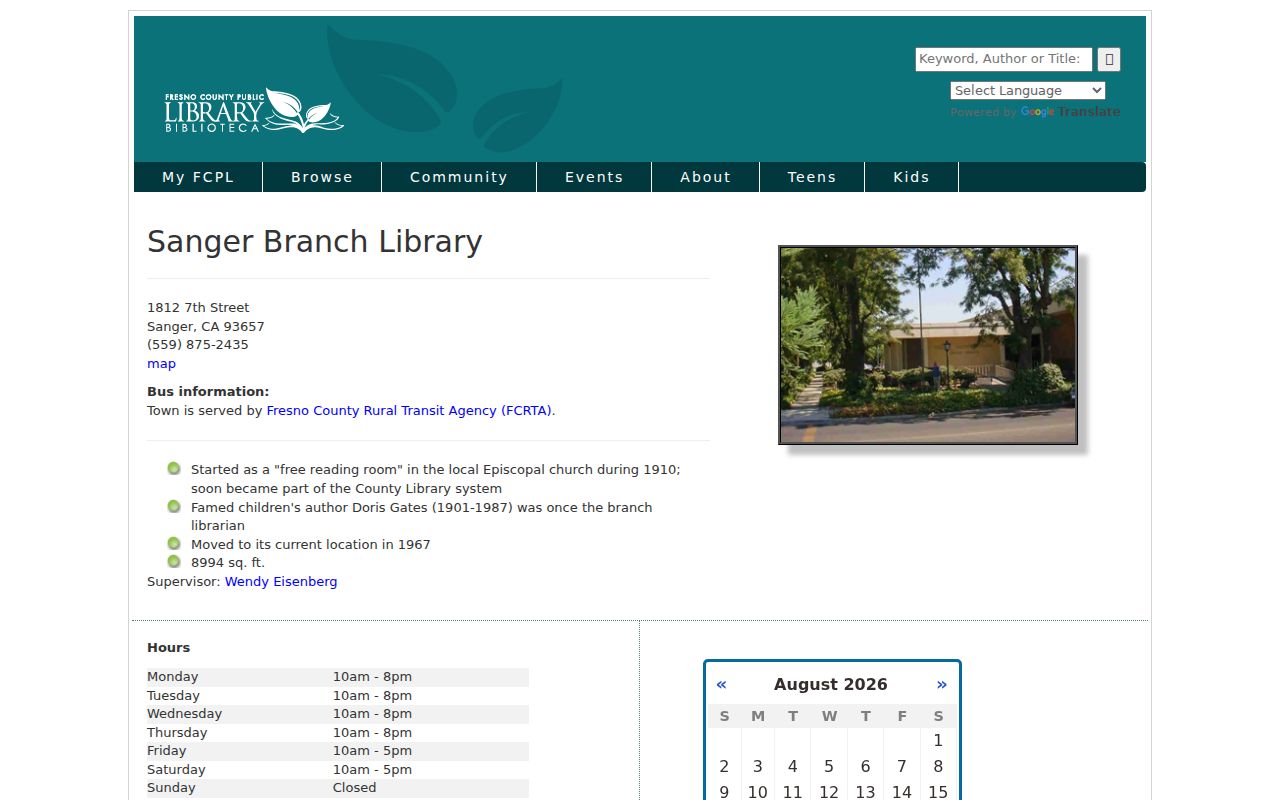
The branch is a useful local access point, while the Fresno genealogy room remains the deeper home for microfilm and county history.
How a Sanger City Directory Entry Reads
A Sanger directory entry is an editorial snapshot, not a deed or a complete household census. Polk and Haines traditions commonly place a surname first, then a given name or initial, with a spouse in parentheses, a widow note, an occupation or business line, and a residence address. The business address may be separate. A street or criss-cross section reverses the order and starts with street name, number, resident, or telephone.
| Name | Surname, given name or initial, with variants worth copying exactly. |
|---|---|
| Spouse or widow note | A spouse may appear in parentheses; widow notation can preserve a family clue. |
| Occupation or business | A trade, role, or business line can separate people with the same name. |
| Residence status | r marks residence and h marks householder in the described tradition; neither proves title. |
| Address | House number and street, with a separate business address when supplied. |
| Reverse entry | Street name, number, resident, and telephone in a criss-cross section. |
- Criss-cross directory
- A reverse volume arranged by street and number, useful when the address is known but the name is not.
- Householder index
- A name or household list that points to an address, but may not list every person in the home.
- Abbreviation key
- The edition's front matter that defines marks such as
r,h, and widow or trade abbreviations.
Sanger Directory Marks Need Context
Read the front matter before expanding any mark. A missing spouse may reflect editorial practice rather than a missing relationship. A surname may appear with a maiden form, a nickname, a compound surname, or a different first-name spelling. In Sanger, family-history work may also require checking paternal and maternal surname order, spacing, hyphenation, and an Anglicized first name without assuming that two similar entries are the same person.
Reading rule. A residence or householder mark helps place a name, but it does not prove ownership, present occupancy, or a family tie. Confirm the clue with another record.
When a historical hit needs a current identity check, compare the name with an address, date, and related person before moving to the Sanger resident lookup. A directory is strongest as one link in a chain, not as a stand-alone answer.
Sanger Directory Companions: Yearbooks
School yearbooks fill the social space that a directory leaves thin. They can confirm a student's class, club, team, faculty role, or nickname near a known address and year. The library's Sanger holdings are unusually specific, but the run is not continuous, so a missing year does not prove that a student or family was absent.
- Sanger High's Echo early run: 1913, 1915-1916, 1920-1929, and 1931-1940.
- Sanger High's Echo later run: 1941-1963, 1966-1976, 1980, 1988, and 2005.
- Washington Middle's Warriors: 1974 and 1992.
The Sanger yearbook holdings list is the source for the surviving years.
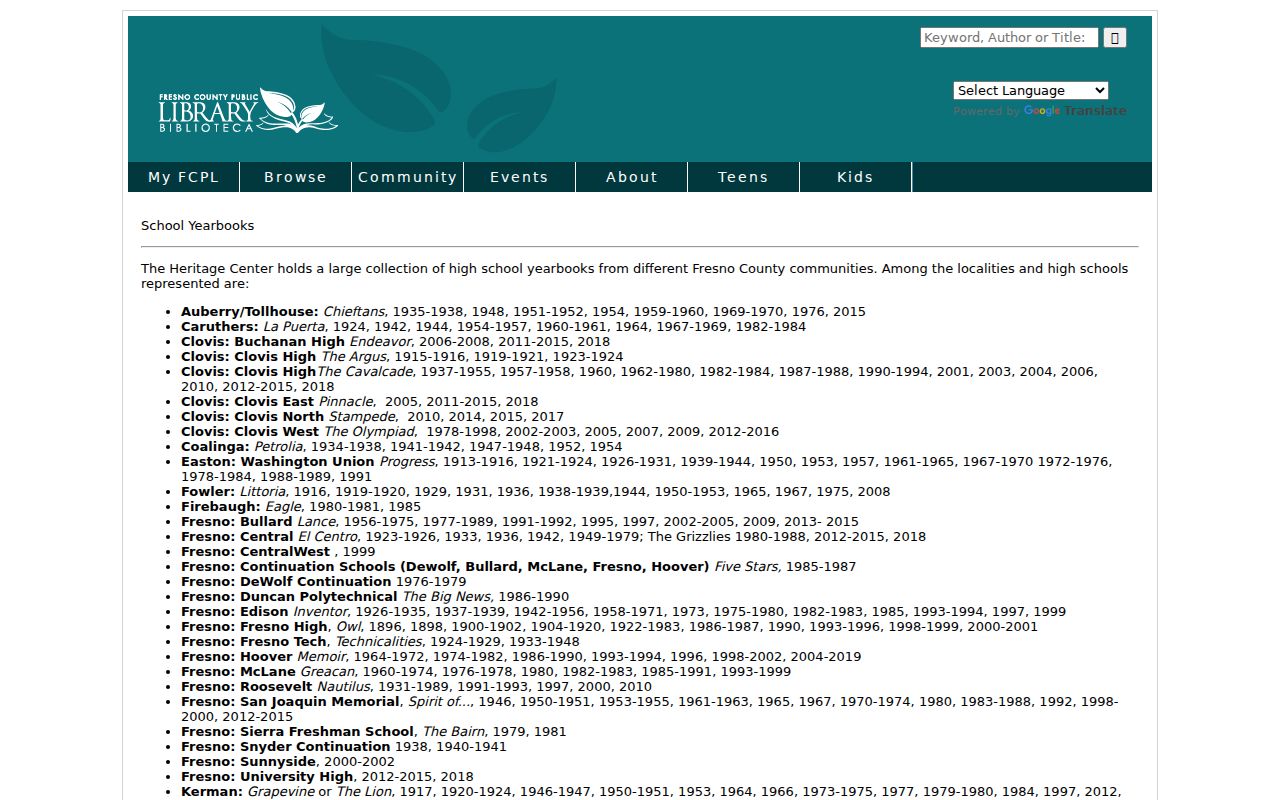
Yearbook captions can hold nicknames or maiden names, so pair them with a directory or census instead of treating a caption as final proof.
Sanger Herald Adds Directory Clues
The Sanger Herald extends the directory trail from September 1920 through December 2008 across 77 microfilm reels. Search obituaries, marriages, school news, property notices, civic clubs, and business advertisements. These items can explain why a household appears, disappears, or changes its name between directory years. They also add community detail that a short entry cannot show.
The Sanger Herald microfilm record confirms the run and reel count. Start with a date clue from a death record, cemetery note, yearbook, or directory, then inspect nearby issues because a notice may run more than once.
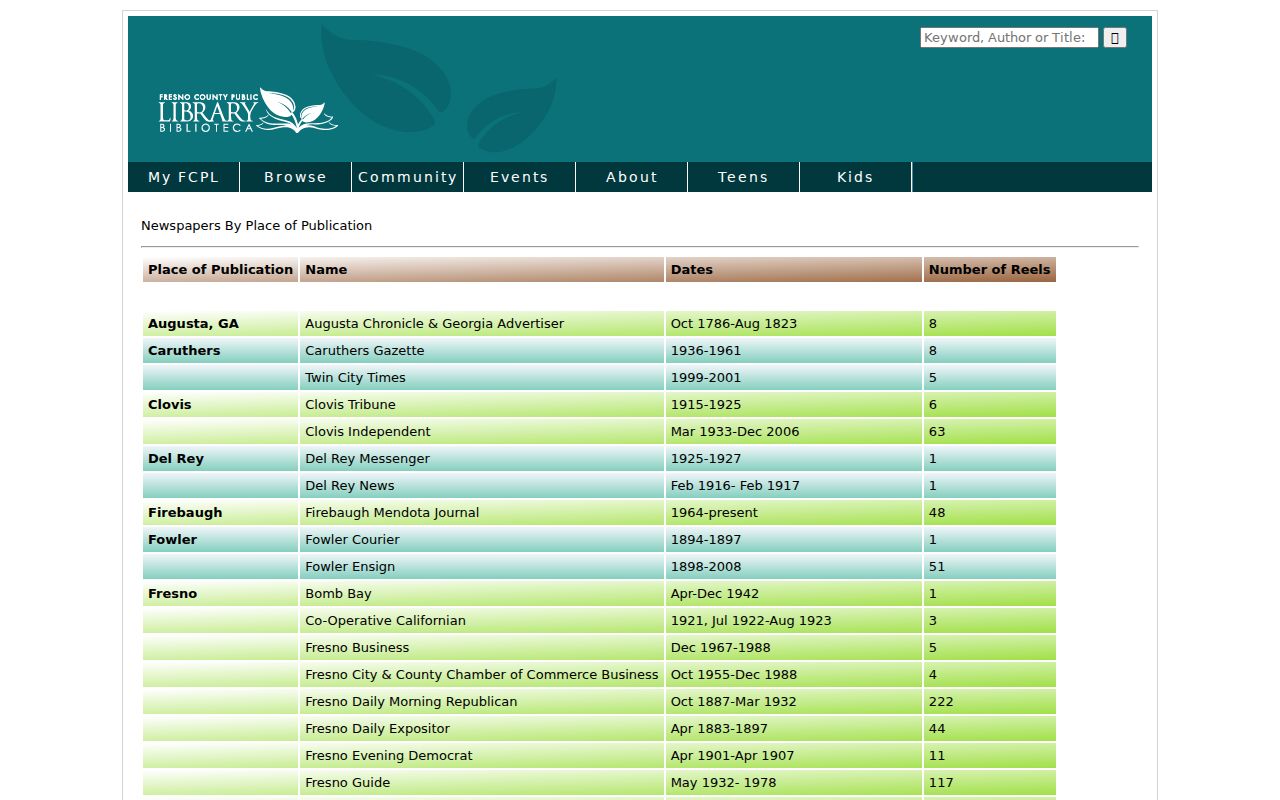
Microfilm is image-based, so a tight date range and a copied surname spelling make the search far faster.
Sanger Sanborn Maps Anchor Directory Addresses
Sanborn fire-insurance maps provide the built setting around a directory address. The surviving editions are April 1891, May 1893, July 1898, August 1907, May 1916, May 1923, and an updated May 1923-January 1945 set. The three earliest editions are digitized in color through the Library of Congress Sanger collection; later runs are available through local microfilm holdings.
A Sanborn sheet can show a building footprint, construction material, use, street name or number, and water or fire infrastructure. It does not name occupants. Compare its street labels with a directory, deed legal description, or census district before deciding that two address forms describe the same place. A map can also reveal when a small commercial or residential block changed shape.
Tracing Families Through Sanger Directories
Use the nearest surviving directory year to anchor a household, then pair it with a public census year and a local newspaper. The goal is a measured trail, not a single match.
- Copy the name, spouse note, occupation, street, number, and every mark from the first likely volume.
- Follow the name through the next available Sanger Polk, Haines, or telephone issue and record each address change.
- Use the address to choose a census township, precinct, or enumeration district, then compare household members, ages, birthplaces, and relationships.
- Use yearbooks or the Sanger Herald to test nicknames, school ties, marriages, moves, and death dates.
- Close with a deed, probate file, cemetery record, or other custodian-held record when the research question needs stronger proof.
Federal population schedules through 1950 are public under the 72-year rule as of 2026. Start with the free 1950 NARA name and location search, inspect the enumeration-district image because OCR can fail, then work backward through 1940, 1930, and earlier schedules. The mostly destroyed 1890 schedules make Sanger directories, deeds, Sanborns, and newspapers especially important bridges.